20% off on product page · save $5.00
Scent Combinations: Create Your Signature Fragrance
Create a Signature Fragrance: A Guide to Scent Combinations
A familiar perfume can feel surprisingly different when you pair it with another scent. Layering gives you room to play: a bright citrus can feel more grounded with woods, while a floral may take on a softer character beside musk. The goal is not to follow a formula, but to find combinations you enjoy wearing.
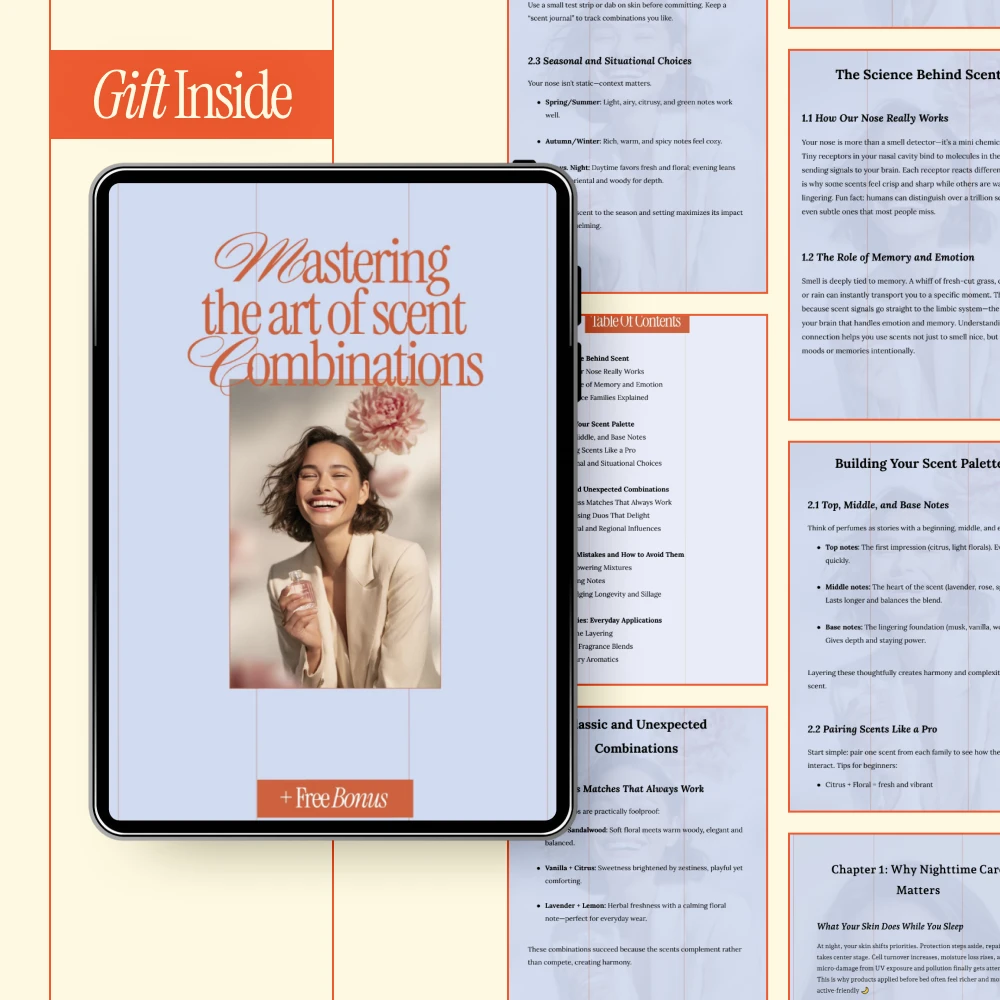
Our Mastering the Art of Scent Combinations ebook is a resource for exploring scent pairing, perfume layering, and signature fragrance creation. To get started, all you need are two fragrances and a little time to see how they develop.
Check the product’s listed specifications when evaluating create a signature fragrance: a guide to scent combinations.
Start With What You Enjoy
Top notes are the first impressions you notice. Middle notes emerge as a fragrance settles, while base notes tend to last longer and add depth or warmth.
Think beyond the first spray. If you enjoy both a citrus opening and a woody finish, a softly woody companion may be worth trying. Working with just two fragrances makes it easier to notice what each contributes.
Mastering the Art of Scent Combinations – Ebook Guide to Good Scent Combinations, Perfume Layering & Signature Fragrance Creation
View product
Four Pairings to Try
These are starting points, not rules. A pairing can develop differently on different people’s skin.
- Citrus and soft woods: fresh with a grounded finish.
- Floral and musk: soft and rounded.
- Vanilla and spice: warm and expressive.
- Green notes and citrus: crisp and bright.
Test each fragrance separately first, then compare the combination after it has settled. What begins brightly may become warmer or softer over time.
Layer With a Light Hand
Apply a small amount of each fragrance and wait before adding more. You might try the heavier scent first and the lighter one second, then reverse the order another day. Alternatively, apply them to separate areas of skin to experience them together without layering directly.
Follow each product’s directions, avoid applying fragrance to irritated skin, and stop using it if irritation occurs.
Check the product’s listed specifications when evaluating layer with a light hand.
Build a Signature Scent
A signature scent does not have to be the same combination every day. It can be a pairing you return to because it feels comfortable and distinctly yours, whether you wear it for an ordinary morning or an evening out.
Keep a brief record of each experiment: write down the fragrances, the amount of each, the order you applied them, and your impressions at the beginning and later on. Revisit a favorite at different times of day, then adjust one element at a time. Changing only the amount or order helps you understand what made the difference.
It is a resource for exploring good scent combinations, layering, and creating a fragrance approach that feels personal.
If you also enjoy expressing your style through clothing, our Must-Have Fashion Pieces Bundle offers five guides to simplifying your wardrobe. Fragrance and clothing can be considered separately or chosen to suit the same occasion.
The Ultra-Thin Foundation Brush works alongside the featured product and loosens and collects dog hair from car upholstery and seat seams.
Before choosing, compare the product details with your daily routine, available space, care needs, and preferred setup. The strongest option is usually the one that fits the intended use clearly and remains simple to clean, store, and check before repeat use.
FAQ
What scents inspire creativity?
Scent responses are personal, so there is no fragrance that reliably inspires creativity for everyone. You might enjoy experimenting with citrus, herbal, or woody scents while working on a creative project, without expecting a particular effect.
What is the 30/50/20 rule for perfume?
Ratios such as 30/50/20 sometimes circulate as fragrance-building or layering guidelines, but there is no universal rule for wearing perfume. Start with small amounts and adjust the balance according to what you enjoy.
What scent did Jesus use?
The Bible mentions fragrant substances such as myrrh, frankincense, and costly perfume in accounts associated with Jesus, but it does not establish a personal signature scent he regularly wore.
How much do master perfumers make?
Pay varies widely by employer, location, experience, and role, and there is no single reliable salary for every master perfumer. Current job postings and compensation surveys can provide context for a particular market.
See if Mastering the Art of Scent Combinations – Ebook Guide to Good Scent Combinations, Perfume Layering & Signature Fragrance Creation fits your setup
View product









Leave a comment